Friday, December 6, 2013

A Field Trip

Our mission for this day was to visit Entreamigos, an amazing community center in San Pancho. It was a three-bus trip, from La Cruz to San Pancho. The first was a “collectivo”, a privately-owned van that seats 16 people when crammed full as they often are, which dropped us off on the main highway.  We darted across four lanes of traffic and waited under a concrete overpass for the bus to Sayulita which rattles and snorts, climbs and grinds along the downsized two-lane highway through the jungle before arriving at its terminus.  This surfer-hangout town is known for its healthy lifestyle and with fresh fruit juice and smoothie bars on every corner and in between, we just had to choose a vendor.  We savored our smoothies as we waited 40 minutes at the outdoor bus terminal, a collection of bus seats set in the dirt under a tin roof, for the next bus to San Pancho.

It was worth the wait.  The bus dropped us off on the highway and it was a short walk down the colorful main street in San Pancho to Entreamigos, a non-profit, community-supported education center.  The entrance to this old milk processing plant is wide and high, drawing one’s gaze up and through the immensity of the space.

The building sat abandoned from the 1970s until 2009 when the government gave Entreamigos the rights to occupy and remodel the building.  It is a recognized model of environmentally responsible design.  Recycled materials were used throughout. Sunlight pours through skylights in the reception area, library, computer lab and study areas.

Deeper into the space is a sports area with trampolines and gym mats; eco-design workspaces for sewing, screen printing, glass and metal works; a recycling area and a recycle shop. 

Outside are an organic garden and a play area. 
This is a busy place where materials collected in town are repurposed; plastic detergent bottles become toys, a velvet blouse becomes lovely purses, a car hood becomes a blackboard, egg cartons are lamp shades, glass bottles and jars become vases, cups and ornaments. 

Nothing is wasted. Classes are taught by volunteers, visiting artists, local inhabitants, anyone is invited to give a workshop, to share their talents inspiring others to take care of their planet and contribute good things.  Oh, and while we were there, a Navy League member from Puerto Vallarta came in and purchased 20 toys that will be distributed to Families at the Dump for Christmas!  This is an amazing place.  You can learn more about it at www.entreamigos.org.mx. 
We were standing on the highway waiting for the hot, rattily return bus to La Cruz when a big, plush Pacifico long-distance bus pulled up and stopped. They had a few empty seats and invited us aboard.  Cushy, reclining seats, air conditioning and a movie - what a way to end a great field trip day!  
 

Wednesday, November 20, 2013

Waiting in La Cruz


We’re waiting in La Cruz for refrigeration parts, which gives us ample time to complete a myriad of boat chores, from the nastiest (blasting the concrete out of the sanitation hoses) to the prettiest (sanding and oiling the rub rails and side rails).  In between chores, we make daily dingy trips to town for blocks of ice and fresh vegetables.  Occasionally, we hop on a bus for a wild ride to Home Depot or the chandlery in PV.   

Last week, we took the bus to Sayulita, a small beach town about 10 miles north.  It’s a compact town stuffed with tourists and surfers, some of whom appear to have been dropped off in the 70s and stayed.  We wandered the narrow, cobbled streets and settled at a breakfast bar on the town square for chilaquiles and smoothies.

We accomplished alot down below on this gray, rainy day and were treated to a magnificent sunset.    

Sunday, November 3, 2013

La Dia de Muertos


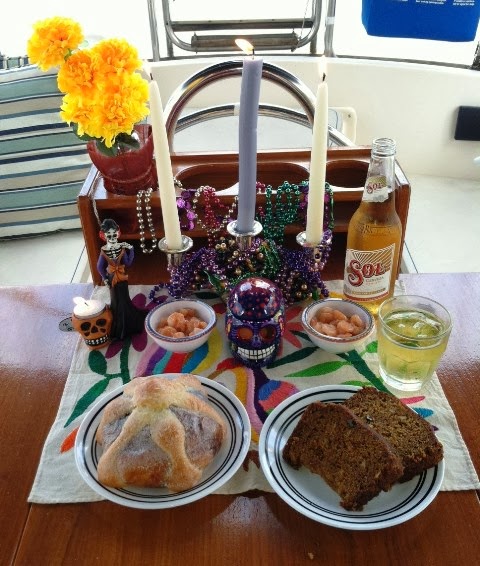
In Mexico, the tradition to honor the dead began with the Aztecs.  Today, The Day of the Dead is celebrated with parades and costumes and parties that stretch over three days, but the most traditional activity is to build an altar.  Whether created in the home or in the cemetery the components are the same: marigold flowers, a skull, the delicious Bread of the Dead made only this time of year, candles, photographs, incense, and the favorite food and drink of the departed.  And, oh yes, a likeness of La Catrina, the woman considered to be representative of the dead.  All of this to entice the spirits to happily return for a brief visit.
In oppressive late afternoon heat we caught a bus that wound its way along the cobblestone streets to El Pantheon, the oldest cemetery in old town Puerto Vallarta.  Police blocked off the street out front and vendors set up stalls along the sides.  Just about everything needed for the day could be purchased at the entrance. 


Walking through the massive white concrete arch of the cemetery is like walking into a small town.  The ground is uneven, the dirt passages rocky.  This place has been around a long time and it’s crowded.  Crypts of every size fill the space.  They cascade up and down the hillsides.  Some are low to the ground and simple.  Others rise up to the size of a shed made of brick or stone or adorned in decorative tile with doors protecting the photos and flowers and candles. Some plots are nothing more than a cross stuck in the dirt bearing a family name, reserving the space.  


It was a busy place.  Entire families brought buckets of water to wash the crypts and then rolled on a fresh coat of bright white paint.  Silk flowers suddenly appeared in giant urns, trees were trimmed, the dirt swept.  When the kids got bored, they climbed over, under and around.  Not to miss entrepreneurial opportunities, two small boys wandered about the spirit houses selling cold beverages from a cooler trailing behind them. A tall staff with dangling bags of pink and blue cotton candy bobbed in the distance as the vendor stepped carefully amongst the departed.     
I wanted to honor my departed friends and family members so I gathered the traditional bits and pieces and built an altar.  There was a skull, marigolds, La Catrina, and food and beverage for everyone.  As the edibles all disappeared, I’m assuming that my spirit visitors enjoyed their stopover.


Thursday, October 17, 2013

Magisterio


Hope Road is muddy and deeply rutted from the heavy summer rains.  Our drive is laborious, our snail’s pace symbolic of the long road of transformation experienced by the families living and working at the transfer station at Magisterio, a village on the outskirts of Puerto Vallarta.

This seems an unlikely place for the new construction of a 70+ unit apartment building, an adjacent community center, classrooms, laundromat and soccer field/basketball court.  Rounding a curve in the road the project looms up, its juxtaposition as powerful as the hope of the aspiring tenants. The work accomplished by the non-profit Families at the Dump since my visit in April is amazing.  (www.familiesatthedump.com) The Foundation has worked for years to break this cycle of poverty, a testament to their constancy and dedication. Kids are sponsored in school, adults are learning new job skills, micro-loans are providing small business startups, a daycare center provides lunches, kids are engaged in art and games at the activity center, a computer classroom connects them to the world. And sometime within the next year families who have demonstrated the greatest desire to change their lives, who have applied themselves and focused their hearts and minds on a better life will leave their shanties and move into these new apartments with running water, toilets, refrigerators, cooktops, tile floors, ceiling fans, beds to sleep in, chairs to sit in, a table at which to eat, doors and windows, and walls that don’t flutter in the wind or leak during torrential downpours.
I volunteered at the community center on a hot, humid day when there was a lot to do.  Four of us spread the load.  We served lunch, a pasta salad that we scooped up and slathered on tortillas, to about 50 kids but only after inspecting the small hands of each child confirming that they had used the wash station outside the lunchroom. 


We washed dishes changing the cold, soapy water several times, re-using the plates so that everyone had a meal.  For some, it would be the only one of the day.  We spent time in the activity center making Halloween masks, with the kindergarten class learning numbers, and joined the middle school kids for belly dancing and yoga before they left for their afternoon sessions. In the coming weeks, I’ll be teaching English during the morning session. 
 
Once again, I left this amazing place awed by the strength of the human spirit and the fundamental goodness of humankind.  

Passing debris


It’s called “debris”.  The shifting winds, big swells, and torrential rains resulting from a cyclone that passes nearby but not close enough to cause real damage.  Well, its 9:00 Saturday night and we suddenly find ourselves in the debris field of a cyclone.  Its 86 degrees in the cabin; two oscillating fans blow the warm air around and trick us into thinking that we’re cool.  Heavy rain sounds like tap dancers on the cabin top; some of it bounces through the open portholes; some of it pings sideways into the cockpit.  Lightning flashes.  Thunder claps.  Wind gusts create a welcome breeze.  In the aft cabin, we hear the distinct plopping of raindrops crescendo into a rivulet, discover a leak in the hatch and place a bucket on the floor.  The stream becomes constant and quickly piles up in the bucket.  It’s a torrent outside.  I’m nervous and patrol down below for more invading rivulets.  Suddenly at 9:30, the only audible sounds are the whirling fans and occasional drips.  Outside, a fine mist hovers around the canvas.  The wash down is complete.  Depending on location, rain measurements for the 30-minute deluge are from 1-1/2 to 2 inches. 

Tuesday, October 15, 2013

We're back!


In early October, we arrived to the oppressive heat and humidity of Puerto Vallarta.  After crossing the border at Nogales, we bounced our way down 1,200 miles of Mexico’s finest highways. We paid $100 US in tolls for the privilege of dodging potholes and driving on narrow lanes without shoulders.  We stopped at our favorite campgrounds: San Carlos in the desert, Los Alamos in the mountains, and Mazatlan in the tropics.  All were practically deserted leaving us feeling a bit lonely and realizing that we were a couple of weeks ahead of the southerly migration.  We saw just one other RV which was northbound.    

We were relieved to find that Gitane was well-cared for during our summer absence.  Down below, the dehumidifier kept her dry, mold was non-existent, and she was free of bug infestation.  Now, the hard work begins to get her seaworthy for our second season cruising Pacific Mexico.

We work into the early afternoon when it gets too hot and humid to move and we head to the pool.  Our long work list is evaporating:  We ordered the refrigeration compressor, furled the sails, turned the dingy engine into an art project to deter banditos, added big dingy wheels for those tricky beach landings, provisioned, emptied the water tank of the vinegar and refilled it three times, changed the oil in the Yanmar, and plugged in the navigation equipment. Whew…so far so good.  

Saturday, May 4, 2013

Decommissioned


For the first time in over seven years, Gitane has been decommissioned and the memories of our first year of offshore cruising are neatly bundled. 

Down below, her folded sails are stacked in their bags, reflective insulation is in all port lights and hatch covers, the watermaker is pickled, the water tank is filled with water and two gallons of vinegar, electronics are unplugged and removed, all surfaces were washed with vinegar, clothes lockers are emptied, the refrigerator is cleaned and dried out, the dehumidifier is plugged in and fans are strategically placed. Topside, sheets and halyards are stowed, all canvas has been removed, the dingy is deflated and lashed to the deck, reflective tarps are tied tightly, extra lines and fenders are in place.  She’s ready to withstand hurricane winds and the torrential rain of a summer in the tropics.

We will spend the summer months exploring the interior of northern Mexico and the western U.S. in our motorhome, “Casa del Sol”, visiting family and friends along the way.  Hiking, biking, swimming and bocce ball are on the agenda no matter where we find ourselves. 

This has been a fascinating year of discovery in the great outdoors.  Living in nature every day, enjoying new friendships, great food and the generous hospitality of the Mexican people have extraordinarily enriched our lives.  We will continue our sailing journey to southern Mexico in the Fall.  In the meantime, you can follow our land cruises on our Facebook pages:  Nancy Arnold-Hunting or Ken Hunting.
Hasta luego!